
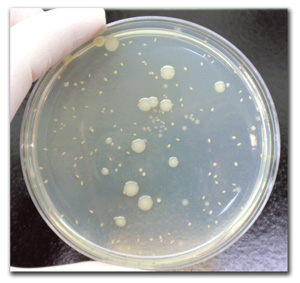
The USP <61> – Microbial Enumeration Test is a product safety test found in Chapter 61 of the United States Pharmacopeia.
It is suggested for use by the FDA for pharmaceuticals as well as cosmetics and personal care products to ensure that a product’s preparation complies with pre-set specifications for microbiological quality.
The USP <61> test is a full quantitative analysis of a product to determine the Total Aerobic Microbial Count (TAMC) and Total Yeast and Mold Count (TYMC) present in the sample.
USP <61> method suitability
Similar to an aerobic plate count assay, the USP <61> test determines the number of colony-forming units present in a product. However, the method also includes a microbial recovery validation conducted with specific microorganisms. This control is often referred to as “method suitability.” It is intended to be run once in the lifetime of the product, before routine testing begins.
The method suitability control proves the microbial recovery scheme employed for a given product neutralizes any antimicrobial agents such as preservatives that may be present in the sample, and ensures the media is conducive to microbial growth. In more simple terms, the method suitability control proves the microbial counts reported are an accurate depiction of the microbial content in the sample at the time of testing.
The bacteria and fungi tested to prove method suitability are opportunistic pathogens whose presence in a cosmetic or personal care product would be a particular concern, especially eye-area cosmetics.
The specific pathogens used to prove method suitability are Staphylococcus aureus, Pseudomonas aeruginosa, and Candida albicans, Bacillus subtilis and Aspergillus brasiliensis.
Acceptable Guidelines for Microbial Limits
Cosmetics and personal care products are not expected to be completely free of all microorganisms; however, they must be completely free of high-virulence microbial pathogens, especially in eye-area products, and the total number of microorganisms in the product must be low. Criteria for acceptable counts present in products is based on BAM Chapter 23, a method from the FDA.
For eye-area and baby products, no more than 100 colony forming units (CFU)/ g or ml of product is considered acceptable. For non-eye-area products, no more than 1000 CFU/ g or ml of product is considered acceptable. If the product is determined to have aerobic microbial counts at or below these levels, further testing under USP <62> – Test for Specified Microorganisms – or an equivalent test may be necessary to determine if those microorganisms are high-virulence pathogens.
How often should USP <61> testing be conducted?
Companies producing personal care products and other consumer products are required to ensure the manufactured products are free from excessive microbial contamination. Generally, personal care companies will test one to three samples from each batch of manufacturing for USP <61>.
How do I get my first sample tested?
It’s easy to set up testing with Microchem Laboratory. Just contact the lab or get a price quote, then a friendly Analyst will walk you through the process, including filling out the sample submission form. USP 61 testing is relatively inexpensive and delivers fast results.