

To keep the individual numbers manageable, microbiologists usually express them using scientific notation. Similarly, when calculating the magnitude of the change in cell number, microbiologists often use a logarithmic scale (log scale).
Simply speaking, taking the log value of a large number, such as the number of cells killed in a disinfectant test, transforms it into a smaller one that is easier to work with. Understandably, this “scientist shorthand” often prompts questions concerning how to translate log reductions to percent reductions and vice versa. A series of true mathematical statements showing a pattern is presented below.
If you can identify the pattern, then you are well on your way to understanding the relationship between log reduction and percent reduction.
- 1 log reduction = 90% reduction
- 2 log reduction = 99% reduction
- 3 log reduction = 99.9% reduction
- 4 log reduction = 99.99% reduction
- 5 log reduction = 99.999% reduction
- 6 log reduction = 99.9999% reduction
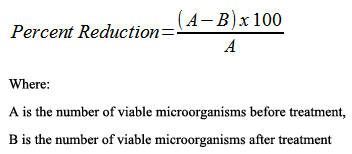
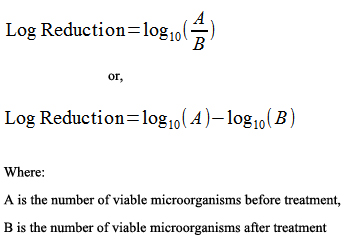
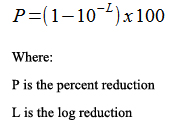
As the series demonstrates, if a log reduction is a whole integer, then its numerical value equals the number of nines in the percent reduction figure. So, if you get a study report from our lab indicating a 2.5 log reduction, then you know it corresponds to a percent reduction somewhere between 99% and 99.9%. However, because of the way log scales work, a 2.5 log reduction does not equal a 99.5% reduction. For the more mathematically minded, formulas are presented below for percent reduction calculations, log reduction calculations, and finally a formula is presented which will allow people to go back and forth between the two.
Percent Reduction Calculation
Log Reduction Calculation
Formula to Convert Log Reduction to Percent Reduction
Formula to Convert Percent Reduction to Log Reduction

Hopefully this page has been helpful. If you ever have any questions about a study report from our lab or any other commercial microbiology lab, we are glad to help you understand it.
Real-world examples from our testing lab
- A client tests a wound dressing for its ability to kill MRSA. We challenge the product with one million cells. After treatment one hundred cells remain. That’s 10^6 cells (1,000,000) brought down to 10^2 cells (100), a 4 log reduction, or 99.99%.
- A client wants to test sterility of a medical device after gamma irradiation. They measure bioburden on the device at 4 x 10^3 cells (4,000). After gamma treatment there are four cells detected. That’s a 3 log reduction, or 99.9%.
- A client submits a liquid product for dietary supplement testing. USP <2021> analysis shows there are 10^3 (1,000) bacteria per gram. The client thinks it was a dirty manufacturing run and trusts their preservative testing, which showed microbial reductions over time. They test the same product a week later and there is just 1 cell. That’s a 2 log reduction, or 99%.
Please link to it from your social media or website if you found it informative.
A special thanks goes out to Spencer Rex for his help in crafting this page.